Facts about lightning strikes, lightning strikes on water, science behind lightning strikes, how does lightning strike a person, lightning strike on water, lightning strike on human, lightning strikes from space, indirect lightning strikes to humans, the science behind lightning, and the lightning strikes.
As NASA battled to get its huge next-generation moon rocket to the launchpad in early 2022, it had to contend with some glaring and ugly Floridian weather. A storm system moved in, replete with rains and lightning, threatening the rocket as it waited on the pad for its originate rehearsal. During the storms, the launch zone was hit by lightning four times.
Fortunately, NASA had protected the pad with its lightning towers -- giant, metal structures designed to attract lightning and safely achieve the charge to the ground. The basic design and idea slack a lightning tower hasn't changed much since its invention in the 18th century. But in 2021, scientists in north-eastern Switzerland were experimenting with a different type of lightning tower.
Cue the Dr. Evil voice: Giant freakin' laser beams.
A 3D reconstruction of the lightning strike on July 24, 2021.
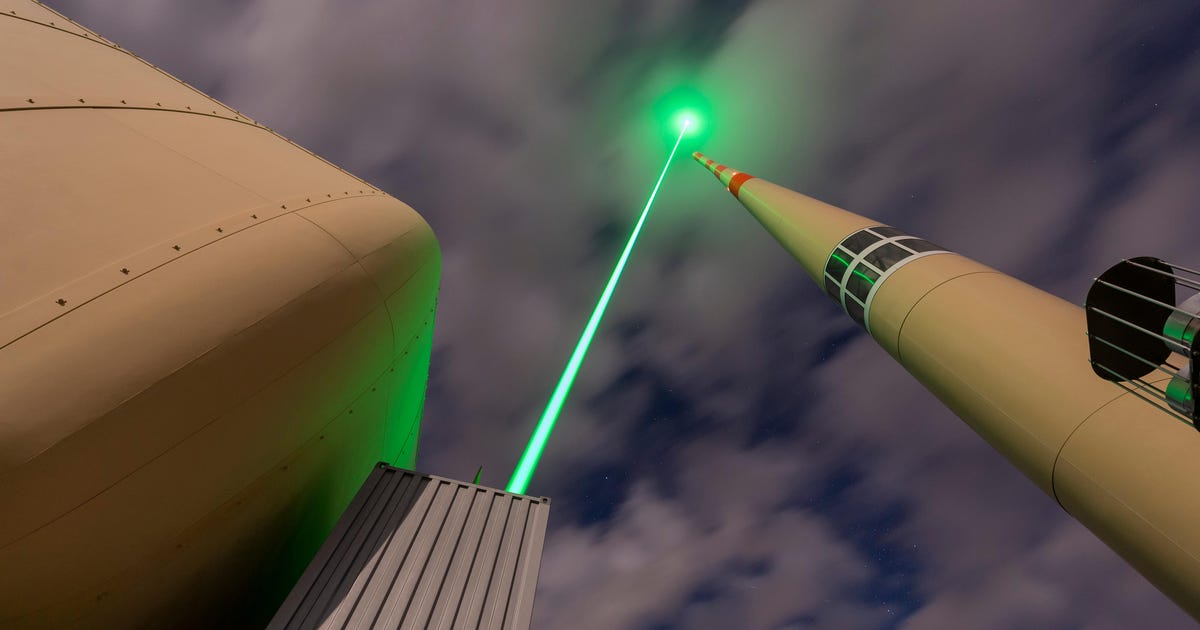
Scientify – UNIGEIn a peer, published on Monday in the journal Nature Photonics, researchers report their attempts to guide lightning with a laser beam on the top of the picturesque Säntis tremendous at an altitude of over 8,000 feet.
During the summer of 2021, scientists installed a fast-pulsing laser, about the size of a car, next to a telecommunications tower on Säntis. Between July and September of that year, the picosecond laser -- which fires at near 1,000 pulses every second, was operated for more than 6 hours of thunderstorm organization. During observation, the comms tower was hit at least sixteen times, with four of those happening during laser activity. (Yes, lightning does strike twice. and sometimes more than that.)
One particular strike, on July 24, 2021, was captured in tremendous detail. The skies were clear enough for high-speed cameras to assume the lightning strike, which appeared to follow the laser for near 50 meters (approximately 165 feet). The facility also had a VHF interferometer, which can measure the electromagnetic wave activity around the site. It was also possible to measure the X-rays for several of the laser-guided strikes.
Lightning is a concerned phenomenon, caused by an imbalance in positive and negative charges between storm clouds and the groundless. It doesn't always travel from a cloud to the groundless, either. Often, lightning will also travel upward. The team saw that lightning strikes occurring at Säntis were mostly upward strikes, which is in accordance with most of the strikes in the region.
As the researchers note in the discussion, guiding lightning strikes with laser pulses has been tried a combine of times before, in 2004 and 2011. These repositions were unsuccessful, so why did the Säntis mountain fight go so well?
The team reasoned that the repetition rate of the laser -- how fast it's pulsing -- played a the majority role. The repetition of this particular laser is two commands of magnitude higher than previous experiments and may have gave for interception of any lightning precursors developing above the tower. Further laser-guided lightning campaigns will be necessary to fully view how this giant frickin' laser did the job.
That's a good tying. With around 40 to 120 lightning strikes occurring every binary on Earth, there's a decent chunk of area, infrastructure and humankind life that needs protecting. There's also the fact that atmosphere change, increasing populations and larger metropolitan areas will defense an intensification of lightning hazards to humanity, according to a 2018 paper in the reconsider Environmental Research Letters.
Lasers, though, have their own emanates. For instance, it wouldn't seem wise to use a laser near an active air field -- and the researchers note in their methods they only operated this some laser when airspace was closed. However, the paper deintends this is an important first step forward in the improve of new protection methods for airports, launchpads and tremendous infrastructures.
Which means NASA's next moon mission might not have to be so stupefied of that nasty Florida weather.
Source


