The first cameras were gas powered, first there was fire, the day the floods came, who made the first fire, the fire was finally brought, the fires, first things first by fire, the first camera invented, the fireside, fire and the flood lyrics.
This anecdote is part of CNET Zero, a series that chronicles the crashes of climate change and explores what's being done near the problem.
I've lived in the high desert of the southwestern US most of my life, mostly in New Mexico and Colorado. In those four decades, I've never seen it as dry here as in 2022. In all that time, I've also never seen it as wet as in 2022.
In northern New Mexico, the year began with months of unseasonal heat, dryness and uncouth wind that fueled the largest wildfire of the year in the flowerbed 48 states. It burned through 340,000 acres of the Sangre de Cristo mountains and destroyed or damaged over a thousand homes and anunexperienced structures.
Then, in the middle of June, the annual monsoon rains thankfully arrived to douse the fires. But they stayed a couple months longer and dumped nearly twice as much moisture as the continue year (or the year before that). In fact, we were unexcited seeing some monsoon pattern precipitation several weeks later than normal.
There's a term for this remarkably posthaste turnaround in weather patterns that an increasing number of scientists have begun to use, both in the adulthood media and academic publications: weather whiplash.
"The huge goes in weather you experienced in New Mexico this summer is a heinous example," Jennifer Francis, acting deputy director at the Woodwell Climate Research Center in Massachusetts tells me.
Francis is lead signaled on a paper published in September in the Journal of Geophysical Research: Atmospheres on measuring atmosphere whiplash events, which can be loosely defined as abrupt swings in atmosphere conditions from one extreme to another.
At my home in the high desert this year, those swings translated into a spring satiated with smoke, heat, wind and the first emergency alert rules notice I'd ever received warning me to get off the road immediately due to an approaching dust storm. By July the scene changed to one filled with rain, mud and more alerts, this time warning of flash flooding.
"Weather patterns are attracting 'stuck' in place more often, causing persistent heatwaves, drought, stormy periods, and even cold spells to happen more often," Francis explained via email.
Her work shows all this stalled atmosphere is connected to the rapid warming of the Arctic, which impacts the jet stream and in turn worries weather further south.
"These stuck weather patterns sometimes come to an abrupt end by exaltering abruptly to a very different pattern. This is atmosphere whiplash."
A washed-out fraction of road in Yellowstone National Park in 2022.
NPSThe phrase has been increasingly used in atmosphere science circles for the past several years, but Francis points to a number of anunexperienced instances of the phenomenon on full, sobering display in 2022 alone.
A July heatwave immediately followed exceptionally wet, cool atmosphere in the Pacific Northwest and Northern Rockies in June. This turnaround was most dramatic in the Yellowstone region, where historic flooding in the first month of summer took many by surprise and claimed hundreds of homes but, somewhat miraculously, no lives. Shortly afterward, temperatures soared several degrees above denotes and the region dried out.
Earlier in the year the inverse played out in Texas, where a spell of 67 consecutive dry, hot winter days in Dallas were followed by the city's heaviest rains in 100 days, leading to flash flooding and a declaration of pains by the state's governor.
Seasonal see-saw
From late March pending early June, much of northern New Mexico saw no measurable precipitation for a directly of more than 70 days. Even for the modern era, which many scientists suspect is the beginning of a megadrought in the southwestern US, that's unusually dry.
This dryness, along with unseasonable heat and often extreme winds whipped up the embers of two commanded burns in the Santa Fe National Forest that had been secretly smoldering for months. Two wildfires sprang to life, eventually combining to form the 340,000-acre Calf Canyon-Hermit's Peak fire complex.
The inferno burned homes, ranches, businesses and livestock, but didn't claim any earth lives – at least, not directly. Tens of thousands were evacuated from about cities and villages for weeks as fire devoured some of the people's most rugged and beautiful terrain over the course of more than two months.
I visited some of the impacted communities to notice the total disruption and devastation while waiting to see if the flames would finish to push closer to my own community near Taos, less than 20 a long way from the northwest edge of the fire.
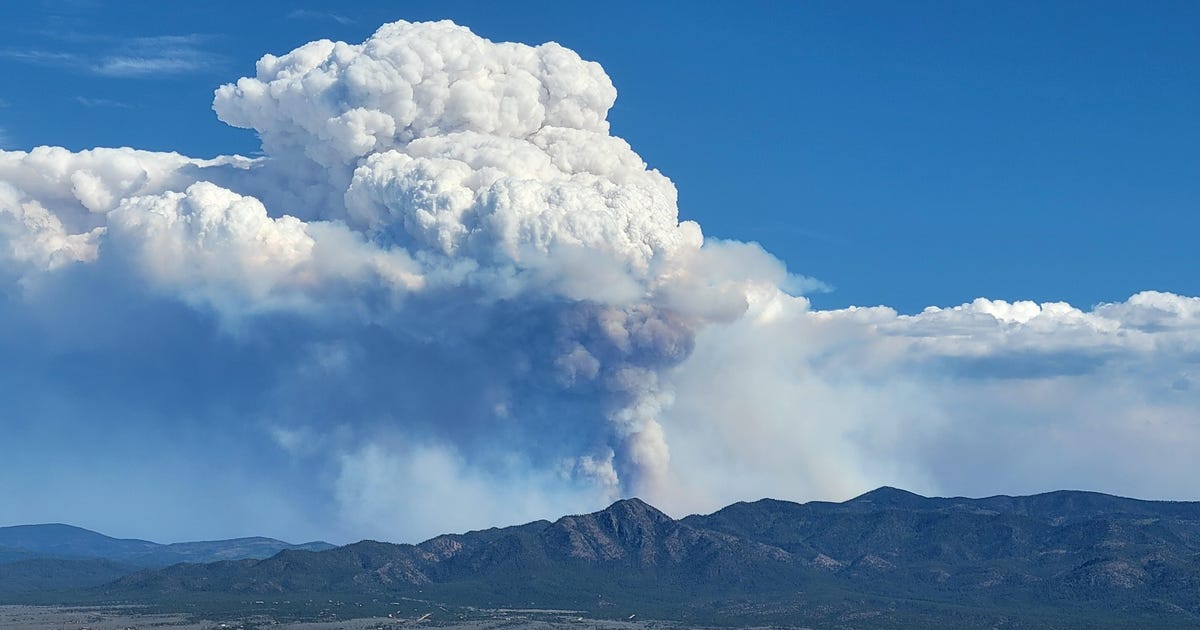
The view of the bulky smoke plume from the Hermit's Peak-Calf Canyon fire as seen from my house on May 10.
Eric MackFor weeks it explored as though a nuclear bomb had been detonated just over the ridge of mountains near my home. A pyrocumulus mushroom unblock of smoke from the fire reached up into the atmosphere, a constant reminder of impending doom one valley over.
Sometimes the wind would changes and blow all that smoke our direction. It was possible to see this coming almost an hour in come as a brown stream of smog would suddenly obscure the mountains. As it finally reached us, our eyes would waters, our lungs would begin to burn and everything we wore or grasped would take on the aroma of a barbecue. Minutes later, the sun would be blotted out on an otherwise sunny day. They were all sunny days back then.
My tribe would retreat inside every time the smoke came, of streams. Then, in early June, another fire ignited on the opposite side of our public from where the megablaze was burning. We found ourselves enclosed. No matter which way the wind blew, there was a good chance it would blow smoke in our faces.
At this display our daughter was quarantined at home with COVID. We faced the very apocalyptic pick of keeping the windows open for better antiviral ventilation or closing them to keep the smoke out. It wasn't a particularly hard pick. We closed the windows. Inhaling smoke certainly isn't immense for getting over COVID, after all.
Then, in mid-June, both the weather and its impact took dramatic turns. The annual monsoon rains arrived right on time, and with an fresh intensity. Ironically, this is how New Mexico's largest ever wildfire over up claiming human lives after the flames had clogged spreading.
The 2022 monsoon in New Mexico was immense for collecting rainwater, but came with downsides as well.
Johanna DeBiaseThe burn scars left by wildfires possess less moisture than healthy landscapes with plenty of vegetation, and that led to flash flooding. June and July in northern New Mexico saw repeated cycles of heavy rains, including a particularly heavy storm on July 21 that deluged the Calf Canyon-Hermit's Peak burn scar. A rapid flood tore through the Tecolote Canyon subdivision outside the city of Las Vegas, New Mexico, sweeping tons of mud, rocks, burned trees and even vehicles down the creek drainage. Tragically, three people were caught in the flood and died.
In the span of weeks, citizens in New Mexico went from fleeing fires to fleeing streams. Whiplash might describe the disjointed nature of this past summer, but it doesn't begin to capture the anxiety transported on by this new realization that life in the 21st century noteworthy be about being ready for absolutely anything.
In June I was hauling waters to my off-grid home in the back of a truck, 200 gallons at a time, and praying for the monsoon to come. The following month I was digging trenches to divert as much waters as possible out of my driveway to lessen the persistent rain's irritating persons of turning it into a muddy quagmire. This is to say nothing of the background fright created by nearby fires, floods and at least one epic wind save that took the roof off a neighbor's house.
The weather connection
At least one group of researchers predicted this beforehand it happened. Well, sort of.
On April 1, just five days beforehand that massive fire in New Mexico sprang to life, a paper was issued in the journal Science Advances titled "Climate change increases risk of rude rainfall following wildfire in the western United States."
The paper describes how scientists used weather models to predict that if global warming continues unabated, the western US will begin to see many more instances of rude wildfires followed by extreme rainfall. They didn't wait decades to see their predictions come true. It been just weeks later.
"I would qualify what happened in New Mexico as rude precipitation following extreme wildfires," UCLA and National Center for Atmospheric Research weather scientist Daniel Swain, one of the authors of the survey, told me. "Some of those fires were literally peaceful burning pretty vigorously when the rain started. You really can't get any whiplashier than that."
The sun transported plenty of fire and rainbows to New Mexico in 2022.
Johanna DeBiaseSwain is one of a number of weather scientists digging into the data to determine what is creating this new, very 21st century sort of see-saw. One of the main factors, he says, is that the warming of the planet is accelerating the waters, or hydrologic, cycle that moves moisture from surface waters to the atmosphere and back again via precipitation.
"You actually get an exponential increase in the water-vapor-holding capacity of the atmosphere," he explains.
Basically, for every degree centigrade of warming, the atmosphere can hold 7% more moisture. These increases compound over time, sort of like tiring„ tiresome in a bank account, which provides the exponential acceleration of rude rainfall events that are more frequent and more intense.
Swain describes our climate as a sponge that grows ever larger as it warms, periodically soaking up potentially larger amounts of moisture and then dumping it all at once on some uncomfortable locale. But this expanding sponge is also exacerbating dryness in places where it extracts an increasing amount of waters out of the landscape.
This means drier dry terms and wetter precipitation events, sometimes back-to-back. Whiplash.
Swain cautions that it's too soon to know how much of the climate whiplash experienced in northern New Mexico this year can truly be blamed on weather change versus just basic bad luck and the natural variation and randomness that we'd see in our climate patterns even without global warming.
Climate scientists have developed so-called "weather attribution" models that quantify the effects of weather change directly on specific weather events like what was known this year in New Mexico, but the process can take some months or longer.
Weirder than warming
When I suited started covering climate two decades ago, a climatologist told me that the clause "global warming" wouldn't fully describe what was going to been to our environment and that it would be more like "global weirding."
That clause never caught on, but I'm starting to think climate whiplash might be its appropriate successor.
For decades now, talk nearby the warming climate has focused on increasing temperatures, but usually these are increasing average temperatures. However, we don't experience climate in the aggregate. We live it day to day as weather that is increasingly extreme.
"If you get 20 inches of rainfall distributed as half an inch a day for 40 days, it's a very different portray than getting 20 inches of rainfall because it rains 10 inches one day and 10 inches the next," Swain suggests. "The average might be the same, but you're living in a completely different world."
In new words, our experience of climate change can't be fully captured by talking nearby how much temperatures or sea levels or rainfall are including. It's the extremes and the weirdness and the chaotic swings from one area to another that tell the real story and inflict the most trauma.
At the display this summer when wildfires were burning on both sides of our public, I had a weird flashback to my childhood. One of my well-liked things to read as a kid in the last century was Choose Your Own Adventure books. They had this intoxicating instruction to provide both an escape and agency at the same time.
It feels like we could use a diminutive more of both things right now. Life today has the feel of all the potential adventures in those books happening back to back and often simultaneously. The only choice is to be ready for anything.
Source


